Furusato nozei for foreigners: rules and 2026 deadlines

Verdict
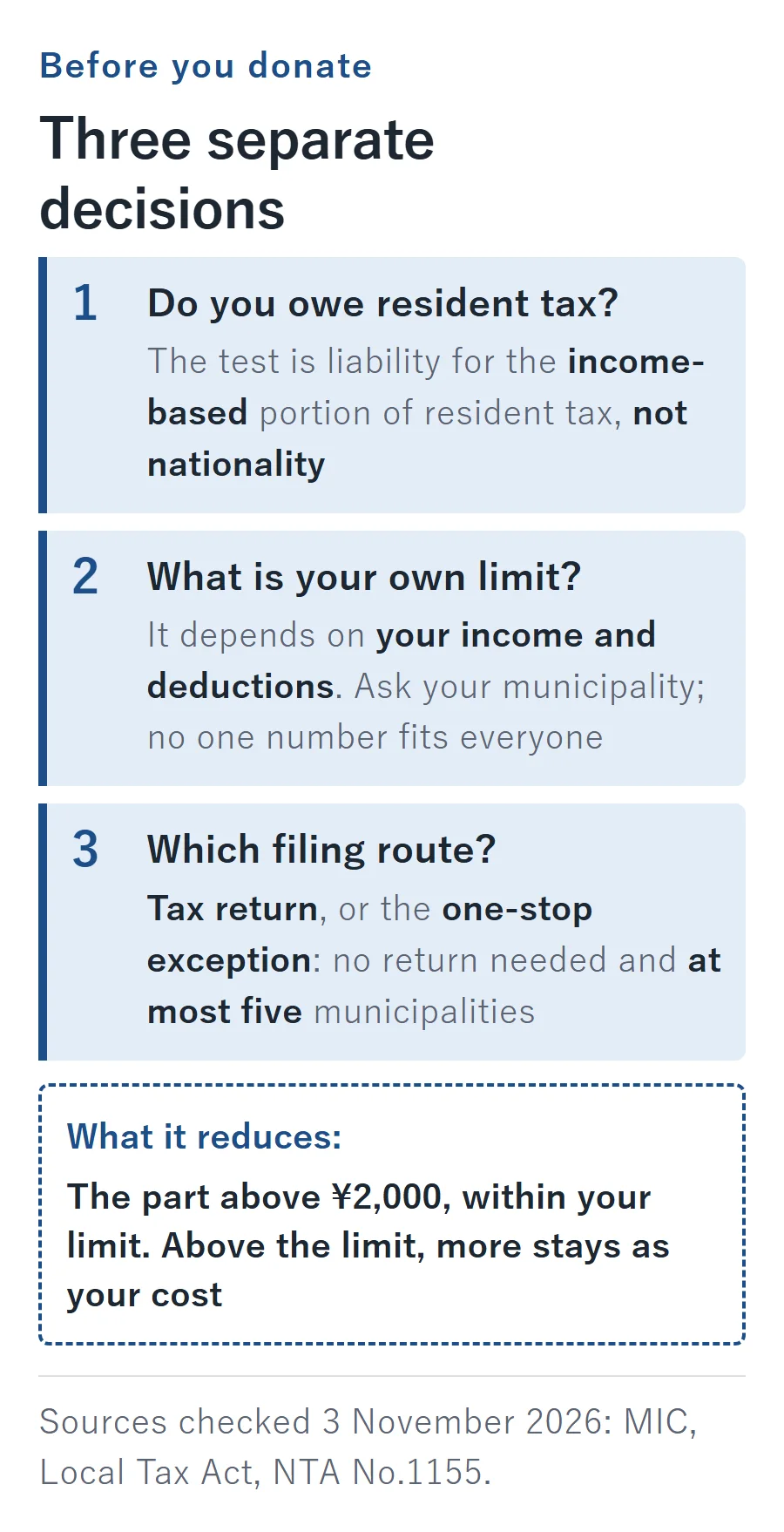
As of November 2026, foreign residents should establish their income-based resident-tax liability and filing route before using furusato nozei: nationality is not the legal test. The scheme redirects part of your income tax and resident tax toward a donation, with the amount above ¥2,000 deducted within a limit and the excess remaining your cost; donations count by calendar year. The one-stop exception requires no tax-return obligation and at most five recipient municipalities: for 2026 donations, Nikko and Kitakyushu’s municipal notices require arrival by Sunday, 10 January 2027, and filing an income-tax or resident-tax return cancels the exception.
Source: MIC – scheme overview and deduction limits, Japanese; Local Tax Act – Articles 294 and 314-7, Japanese; Basic Resident Registration Act – Article 30-45, Japanese; Inagi City – donation year (confirmed 3 November 2026).
Source: MIC – one-stop conditions, Japanese; Nikko City – application deadline, Japanese; Kitakyushu City – application deadline, Japanese; NTA – No.1155, filing and one-stop, Japanese (confirmed 3 November 2026).
What is furusato nozei, and what does it actually reduce?
Furusato nozei, often called Japan’s hometown tax, is a donation system linking eligible municipal donations to income-tax and resident-tax deductions. It is not an unlimited reimbursement of whatever you contribute.
According to the Ministry of Internal Affairs and Communications’ Japanese-language portal, the portion above ¥2,000 is normally covered by deductions within the applicable ceiling. Exceeding that ceiling leaves a larger personal cost. Separate the donation payment from the later tax treatment when organizing your records.
Source: MIC – overview, Japanese; MIC – deductions and excess contributions, Japanese (confirmed 3 November 2026).
The filing route changes where the relief appears:
- Through a tax return: relief is divided between income tax and resident tax, whose calculation includes basic and special components.
- Through the one-stop exception: there is no income-tax deduction; the covered amount reduces the following fiscal year’s resident tax instead.
Source: MIC – deduction components, Japanese; MIC – one-stop treatment, Japanese (confirmed 3 November 2026).
For an English starting point, Inagi City publishes an explanation of the donation-tax system. Use it to orient yourself while keeping national rules and recipient-specific instructions separate. The Japanese-language ministry and municipal sources below provide the reference for the particular deadlines and document lists in this guide, rather than an assumption that every municipality follows identical administrative steps.
Source: Inagi City – English explanation of the donation-tax system; MIC – national procedure, Japanese (confirmed 3 November 2026).
Recipient eligibility is another separate question. Local Tax Act Article 314-7(2) and (9) ties the special deduction to a municipality designated by the minister at the time of donation. Use the recipient’s official information and MIC’s designation notices to establish that status.
The same article’s gift criteria concern locally connected products and procurement costs no greater than 30% of the donation. That procurement ceiling is not a promise about a gift’s retail value or your tax result. Resolve the tax and recipient questions before treating a gift listing as evidence of eligibility.
Source: Local Tax Act – Article 314-7(2) and (9), Japanese; MIC – designation notices and related materials, Japanese (confirmed 3 November 2026).
Can foreign residents use furusato nozei?
The legal test concerns liability for the income-based portion of resident tax, rather than citizenship. Read the residence and deduction provisions together, rather than assuming that either a foreign passport or a residence card settles eligibility.
Local Tax Act Article 314-7 addresses taxpayers liable for that income-based portion. Article 294 connects municipal taxation to residence and the resident register; Basic Resident Registration Act Article 30-45 brings qualifying foreign residents, including mid- to long-term residents and special permanent residents, into that registration framework.
Source: Local Tax Act – Articles 294 and 314-7, Japanese; Basic Resident Registration Act – Article 30-45, Japanese (confirmed 3 November 2026).
This conclusion follows from the statutes’ structure, not a blanket approval of every foreign resident’s circumstances. Where there is no income-based resident-tax amount, there is no amount against which to apply that resident-tax deduction.
Being in a household that pays resident tax does not establish your own deduction capacity: the provision addresses the donor as taxpayer. If the prospective donor is a spouse without income-based resident tax, discuss that person’s position with the municipality. Another household member’s tax assessment does not answer the question of how much tax the donor has available to offset.
Source: Local Tax Act – Article 314-7, donor’s income-based resident-tax amount, Japanese (confirmed 3 November 2026).
Start with your payslip and resident-tax assessment notice. If the relevant liability is absent or unclear, take those records to the municipal tax desk. Someone recently arrived in Japan also needs an assessment of their own position, rather than borrowing an established resident’s donation figure. Arrival during the year can mean a smaller income base; treat that as a possibility to discuss, not as a personal ceiling.
If you have a tax-treaty exemption, ask your municipality how it affects your own eligibility.
Source: Local Tax Act – Articles 294 and 314-7, Japanese; MIC – individual calculation inquiries, Japanese (confirmed 3 November 2026).
How much can I donate, and why won’t this guide give you a number?
There is no personal donation allowance that can be established from nationality or salary alone. Your income, deductions and resident-tax calculation determine how much receives the intended treatment.
Separate permission to give from eligibility for the intended tax treatment. A donation can exceed the deduction ceiling and still be a donation, while leaving more of the payment as your personal cost. The question is how much receives relief, not whether a payment can be made.
The cap concerns several parts of the calculation, not a single universal donation limit. In particular, MIC’s Japanese guidance caps the special resident-tax component at one-fifth of the income-based resident-tax amount. That is a ceiling on a deduction component, not a percentage of salary that you should donate.
Source: MIC – deduction structure and limits, Japanese; NTA – No.1155, Japanese (confirmed 3 November 2026).
Use the ministry’s linked guidance to understand the calculation, then ask your municipality what assistance it provides. Nishitokyo City offers an estimate at its tax counter when a resident brings expected annual earnings and deduction information. MIC also warns that some municipalities cannot answer individual ceiling inquiries. The counter service is therefore a local offering, not a nationwide promise.
Source: Nishitokyo City – estimating the deduction ceiling, Japanese; MIC – municipal inquiry limitations, Japanese (confirmed 3 November 2026).
Treat calculator results as estimates, not an approved donation amount. Tax changes can leave an older calculator behind; the ministry’s current explanation is a starting point for questions, not permission to transplant someone else’s result. Keep the inputs alongside any estimate so the discussion concerns your income and deductions rather than an unexplained total.
Source: MOF – local-tax reform explanation, Japanese; context for calculator-estimate caution; MIC – current deduction guidance, Japanese (confirmed 3 November 2026).
What are the deadlines for 2026 donations?
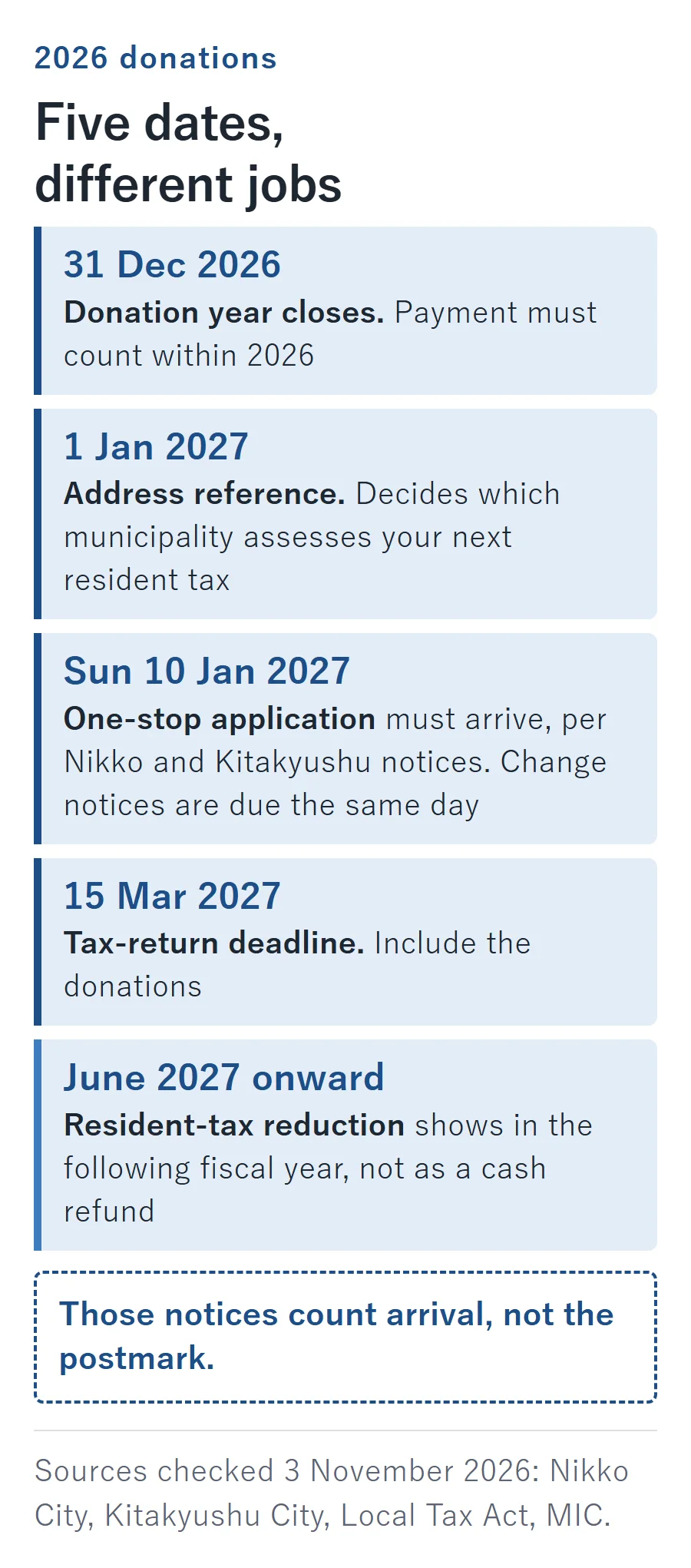
The donation year runs from 1 January through 31 December, while the paperwork continues into the following year. For 2026 donations, keep the payment date, address reference date and application deadline separate.
Source: Inagi City – donation period; Nikko City – 2026 donations, Japanese (confirmed 3 November 2026).
As of November 2026, the relevant calendar is:
| Date | What it concerns | Action or meaning |
|---|---|---|
| 31 December 2026 | Donation receipt date | Payment must count within 2026 for a 2026 donation |
| 1 January 2027 | Address for the following resident-tax assessment | Identify the municipality responsible for that address |
| Sunday, 10 January 2027 | One-stop application | Nikko and Kitakyushu notices specify arrival by this date |
| Sunday, 10 January 2027 | Change notice after applying | Submit to each recipient municipality if application details changed |
| 15 March 2027 | Regular tax-return deadline | Include the donations when claiming through a return |
| June 2027 onward | Following fiscal year's resident tax | Read the assessment notice for the deduction |
Source: Nikko City – arrival deadline, Japanese; Kitakyushu City – arrival deadline, Japanese; Local Tax Act – Article 318 and Supplementary Provisions Article 7(11), Japanese; MIC – change notices and resident-tax timing, Japanese; MIC – tax-return timing, Japanese; Omihachiman City – receipt dates, Japanese (confirmed 3 November 2026).
Nikko’s Japanese notice makes the arrival requirement explicit:
令和9年1月10日(日曜日)必着
Source: Nikko City – one-stop application notice, Japanese (confirmed 3 November 2026).
Plan for receipt by the stated Sunday, not a Sunday postmark or an assumed extension. This application deadline is attributed to the municipal notices; the change-notice deadline is separately stated in the statute cited above.
Payment completion matters too. Omihachiman identifies the card settlement or use date as the receipt date. Bando City’s 2025 year-end notice warned that a payment started just before midnight could finish in the next year; it also told some late-December donors to download their application forms rather than await a mailing. Those are historical examples of year-end handling, not Bando’s unverified 2026 payment cutoffs.
Source: Omihachiman City – receipt-date guidance, Japanese; Bando City – 2025 year-end arrangements, Japanese (confirmed 3 November 2026).
Am I eligible for the one-stop exception?
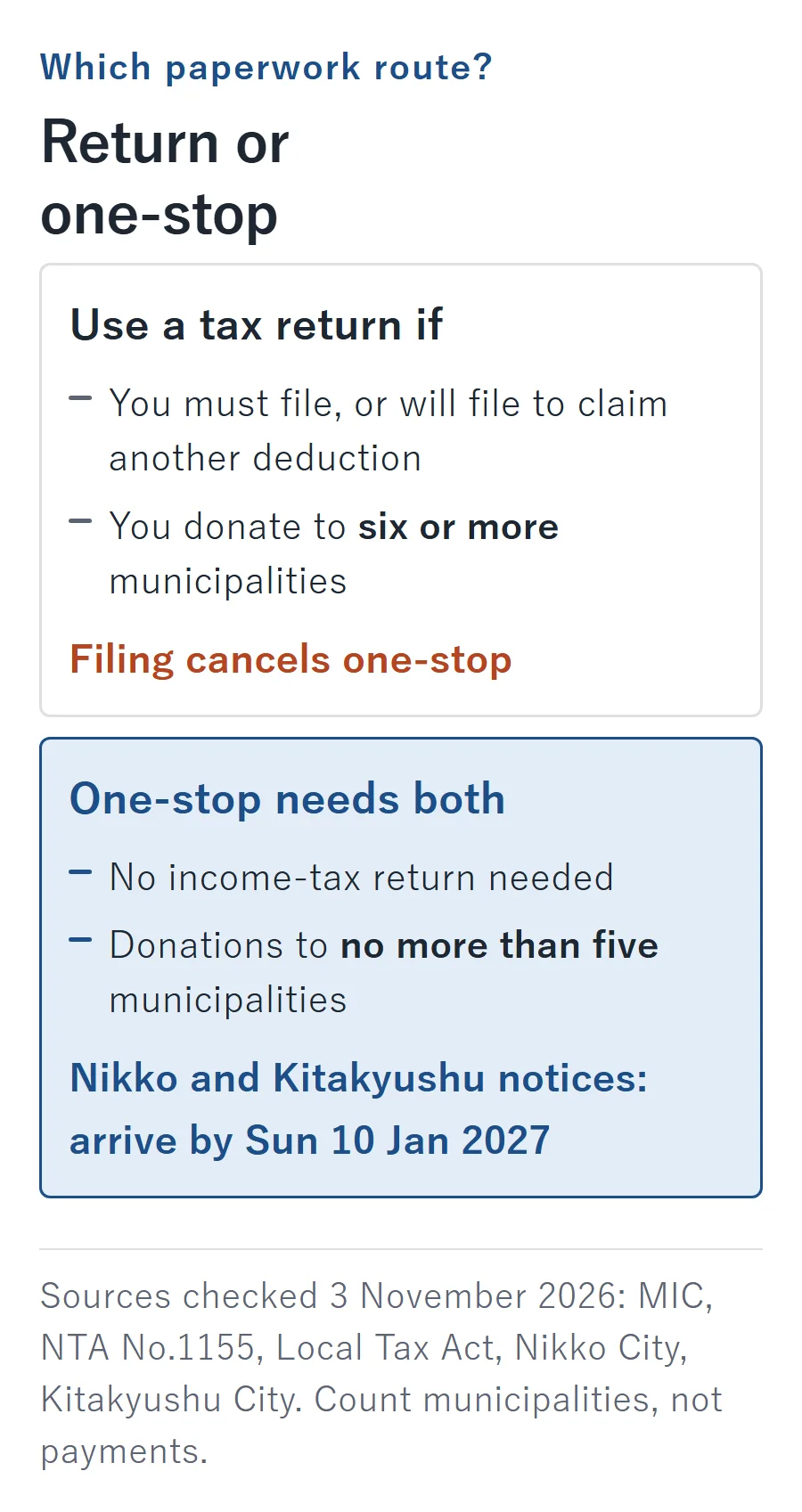
You need both conditions: no obligation to file an income-tax return, and donations to no more than five municipalities. MIC limits it to wage earners and similar taxpayers for whom a return is unnecessary.
Count distinct recipient municipalities, not donation transactions. Repeated donations to the same city do not turn it into several municipalities for this test. Keep a recipient list rather than trying to infer the count from the number of payment receipts.
Source: MIC – one-stop eligibility, Japanese; Nikko City – municipality count, Japanese (confirmed 3 November 2026).
Choose the paperwork route using the whole year’s position:
- A return is required or you will file one to claim another deduction: use the return route for the donations.
- No return is needed, and the recipient count stays within five: the one-stop application route is available, subject to its documents and deadline.
- The count reaches six: use a return for the donations rather than treating only the additional city separately.
Source: MIC – filing routes, Japanese; NTA – No.1155, exceptions to one-stop, Japanese (confirmed 3 November 2026).
Revisit that decision if your filing plans change. Sending an application is not a guarantee that one-stop will remain the applicable route at assessment time.
What documents does the one-stop application need?
Prepare the recipient municipality’s application form, proof of your personal number, and identity evidence. Number verification and identity verification are separate requirements; satisfying one does not remove the other.
MIC says forms can differ between recipient municipalities. Organize the forms and supporting copies by recipient, using each municipality’s instructions rather than assuming a single packet covers every donation destination.
Source: MIC – recipient-specific forms, Japanese; Sakata City – number and identity evidence, Japanese (confirmed 3 November 2026).
Residence-card acceptance is not uniform across the published lists. Sakata lists a residence card among identity documents; Kishiwada’s published list instead names the My Number Card’s front, a driver’s license or a passport, without listing the residence card. Read each recipient’s notice before choosing what to attach; absence from that list is not evidence of a nationwide ban.
Source: Sakata City – listed identity documents, Japanese; Kishiwada City – listed identity documents, Japanese (confirmed 3 November 2026).
Sakata’s number-evidence options include the number-bearing side of a My Number Card and a resident-record copy carrying the number. For the notification card, Kitakyushu warns that a card whose recorded details differ from current information is not valid. An address change therefore deserves attention before you select that document.
Source: Sakata City – personal-number evidence, Japanese; Kitakyushu City – notification-card limitations, Japanese (confirmed 3 November 2026).
Some municipalities accept online applications using a My Number Card; the option is not universal. Use the separate guide to applying for and maintaining a My Number Card as a foreign resident for the card task, then follow the recipient’s own submission route.
Source: MIC – online applications at participating municipalities, Japanese (confirmed 3 November 2026).
When do I have to file a tax return instead?
Filing an income-tax return or a resident-tax return, or applying through a sixth recipient municipality, removes the one-stop route for the donations. Local Tax Act Supplementary Provisions Article 7(13) provides for treating the exception request as though it had not been made.
Source: Local Tax Act – Supplementary Provisions Article 7(13), Japanese; NTA – No.1155, filing and one-stop, Japanese (confirmed 3 November 2026).
A medical-expense deduction is a typical example. Someone who sent one-stop applications and later files for medical expenses must include all the donations on the return, not assume that the earlier applications continue handling them. Losing the exception is not the same as losing every deduction: the return becomes the claim route.
Source: NTA – No.1155, donations when filing another claim, Japanese; Higashiyamato City – one-stop exclusions, Japanese (confirmed 3 November 2026).
For the income and employment conditions that require a separate return, use the year-end adjustment guide’s explanation of who still needs to file; anyone required to file cannot use one-stop.
Source: NTA – No.12018, wage earners requiring a return; MIC – one-stop eligibility, Japanese (confirmed 3 November 2026).
When preparing the return, include the donation entries in the resident-tax area of the second sheet, not only the income-tax donation claim. The NTA warns that omission there can prevent the resident-tax deduction from being applied.
Already filed without the donations? NTA No.1155 describes a correction-request route, but says it is unavailable if the final tax amount would not change; in that situation, contact the municipality. Where there is no income tax and the claim concerns resident tax alone, take the resident-tax return to the municipality.
Source: NTA – No.1155, second-sheet entries and correction requests, Japanese; MIC – resident-tax-only claims, Japanese (confirmed 3 November 2026).
Missing the one-stop arrival deadline also leaves the tax-return route. Contact the tax office promptly about the filing task rather than assuming that a missed application ends every possible claim.
Source: Nikko City – applications received after the deadline, Japanese (confirmed 3 November 2026).
What if I move or leave Japan around 1 January?
The address reference is 1 January of the following year, so 2026 donations connect to the address on 1 January 2027. Local Tax Act Article 318 supplies the resident-tax assessment date.
Source: Local Tax Act – Article 318, Japanese (confirmed 3 November 2026).
If a year-end move changes your details after applying, submit a change notice to each recipient municipality by 10 January 2027. That deadline appears in Supplementary Provisions Article 7(11); MIC also explains the procedure. Sakata warns that one-stop address information is not shared between municipalities.
Source: Local Tax Act – Supplementary Provisions Article 7(11), Japanese; MIC – changes after applying, Japanese; Sakata City – address-information handling, Japanese (confirmed 3 November 2026).
Add the donation-recipient notices to your apartment rental and moving-in steps. Do not treat an ordinary moving notification as completion of the separate one-stop changes. Article 7(13) also addresses a mismatch between the notification destination and the municipality responsible for the assessment-date address.
Source: Local Tax Act – Supplementary Provisions Article 7(13), Japanese; Higashiyamato City – address mismatches, Japanese (confirmed 3 November 2026).
An overseas move that leaves no registered Japanese address on that reference date raises a different question: whether there is a following-year resident-tax amount against which relief can operate. That concern is a reading of the residence and assessment provisions together, not an official statement specifically determining departing foreigners’ treatment. If you intend to leave Japan before 1 January, discuss your dates and registration position with the municipality or tax office before deciding about a donation.
Source: Local Tax Act – Articles 294 and 318, Japanese; basis for the inference above (confirmed 3 November 2026).
A temporary trip is not automatically an overseas move-out. Use the re-entry permission guide for temporary travel from Japan for that separate procedure, without treating permission to return as an answer to the tax-address question.
How do I check that the deduction was applied?
Read the resident-tax assessment notice against the filing route you actually used. For 2026 donations, the resident-tax effect concerns payments from June 2027 onward, not a cash refund arriving that month.
Source: MIC – following-year resident-tax reduction, Japanese (confirmed 3 November 2026).
The relevant field depends on the notice format. Nishitokyo directs people paying directly to the donation-credit entry, labeled 寄附金税額控除, and salary-withholding taxpayers to the remarks on their taxpayer copy of the determination or change notice. Chuo likewise directs salary-withholding taxpayers to the notice supplied through their employer.
Source: Nishitokyo City – locating the deduction, Japanese; Chuo City – donation-to-deduction process, Japanese (confirmed 3 November 2026).
Read the notice yourself; ask the municipal office to point out the relevant line if the Japanese labels are unclear. Chuo uses 申告特例適用除外 in its remarks when one-stop was excluded and directs the taxpayer toward a return. That wording is a municipal example, not a universal placement rule for every city’s form.
Source: Chuo City – when the credit was not applied, Japanese (confirmed 3 November 2026).
If you filed a return, the relief is split between income tax and resident tax. A resident-tax figure below the donation amount therefore does not by itself establish an error. Bring the notice, recipient list and filing history to a discussion about a missing deduction so the office can identify which route needs attention.
Source: Chuo City – income-tax and resident-tax treatment, Japanese (confirmed 3 November 2026).
FAQ
Are return gifts taxable income?
The NTA classifies the economic benefit of a return gift as ichiji shotoku, or occasional income. That classification does not establish the tax due on a particular gift: its small-gift example is not a general calculation for someone receiving several gifts. Take your own circumstances to the tax office rather than assuming that every gift is outside tax.
Source: NTA – taxation of municipal thank-you gifts, Japanese (confirmed 3 November 2026).
Do donation-portal point campaigns still apply?
Under MIC’s revised standards effective 1 October 2025, municipalities cannot solicit donations through intermediaries that award points or similar benefits for those donations. As of November 2026, older advice built around donation-portal point campaigns is therefore not a basis for planning participation.
Source: MIC – revised solicitation standards effective 1 October 2025, Japanese (confirmed 3 November 2026).
Does the new ¥1.93 million cap affect 2026 donations?
No: MIC’s announced fixed ceiling of ¥1.93 million on the special deduction component applies to donations from 2027, not 2026. It concerns very high earners and is not a general maximum on the amount a person can donate. The ministry notes that the basic deduction component remains available under its own rules.
Source: MIC – 24 March 2026 announcement, applying from 2027 donations, Japanese (confirmed 3 November 2026).
Is one-stop the same as year-end adjustment?
No: employer year-end paperwork is not a one-stop application to the donation recipient. Donation deductions belong to the tax-return process unless the qualifying one-stop exception applies; completing payroll’s annual adjustment does not complete that separate claim.
Source: NTA – No.1155, donation claims and one-stop, Japanese; MIC – one-stop application process, Japanese (confirmed 3 November 2026).
What to remember
Establish your income-based resident-tax position and personal deduction limit rather than using nationality or a gift’s value as the test.
Keep donation dates, filing plans, recipient documents and address changes together, then read the resulting tax notice.
Before deciding whether to use the scheme, take unresolved eligibility and filing questions to your municipal office or tax office.